«Theaetetus: By the gods, Socrates, I am lost in wonder when I think of all these things, and sometimes when I regard them it really makes my head swim. Socrates: Theodorus seems to be a pretty good guesser about your nature. For this feeling of wonder shows that you are a philosopher, since wonder is the only beginning of philosophy, and he who said that Iris was the child of Thaumas made a good genealogy».
Plato, Theaetetus, 155d
One of the privileges, and at the same time one of the greatest gifts of art, is its ability to renew our gaze on the world. If this has always been true, contemporary art has, however, added a further feature of subversion that is often misunderstood: we refer, in short, to its bold lack of operational hierarchies, with the consequent risky legitimacy of each practice and instrument which artists decide to make use of. The reconsideration of the perceiving look may therefore take place in different ways and forms – paradoxically also by veiling something, cutting it out from the ordinary inadvertence and thus making it more visible – but always in the light of an original capacity of wonder that, at its best, produces admirable knots of sensitivity and thinking (old Plato, as we have seen, argued that wonder is the proper source for philosophy, and it seems therefore no accident that so much of contemporary art ends up to coincide with operations purely intangible and eidetic, that is to say philosophical).
The case of Mathew McWilliams, a forty years old Canadian artist living between Paris and Sydney, is exemplary in this regard. Through his disparate use of different techniques, ever present is an inner tension towards a thaumaturgical renewal of ordinary perception, giving back to the observer a world transfigured and happily unknown. The writer and artist Josh Thorpe referred to McWilliams’s works by finding in them «a sense of relief from the ravenous habit of looking». We agree indeed, as possibly the (very few) inhabitants of Rivodutri also may have. In fact, this small mountain village of central Italy gently hidden in the woods of the Sabina county recently had the opportunity to experience a similar feeling confronted by an on-site intervention by the artist.
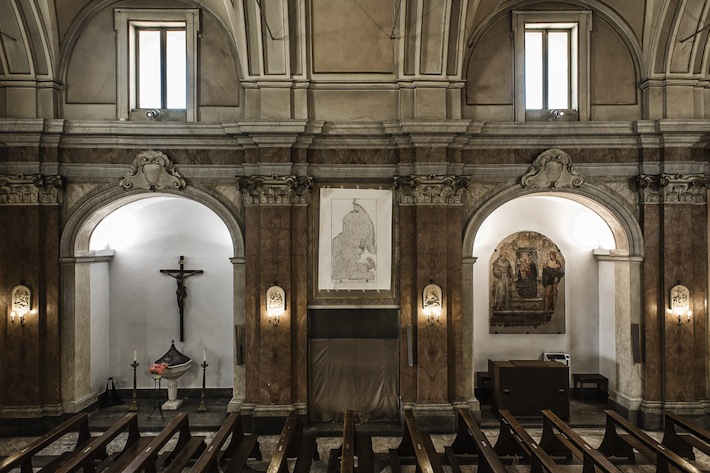
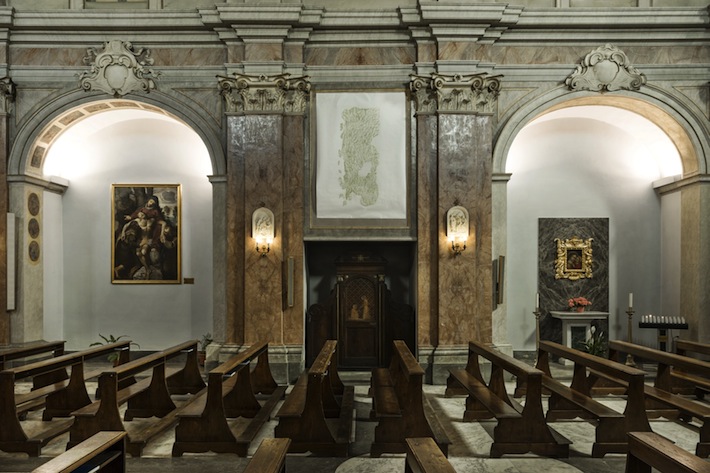
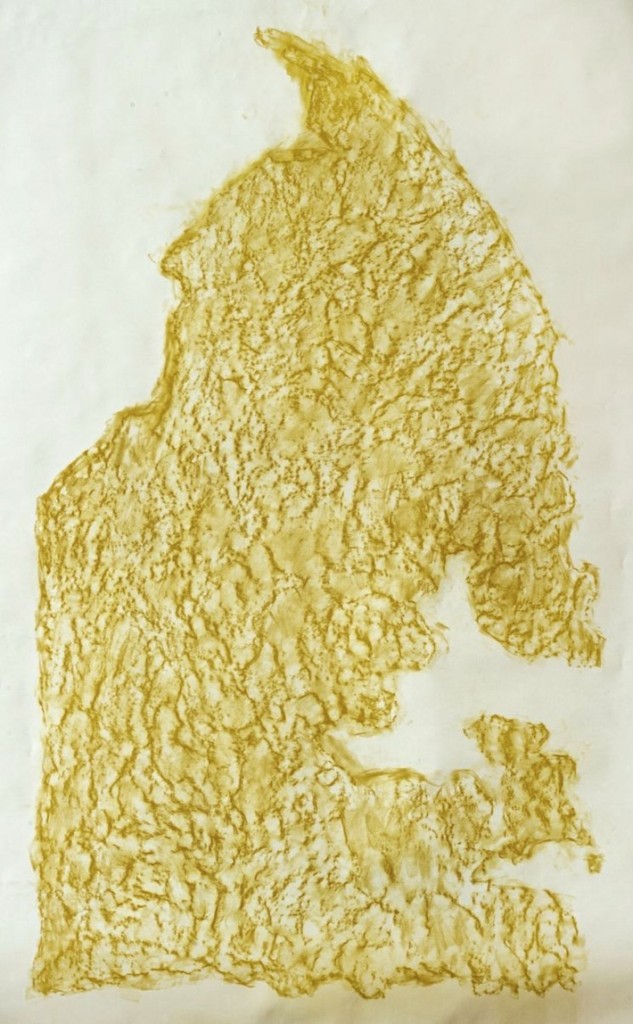
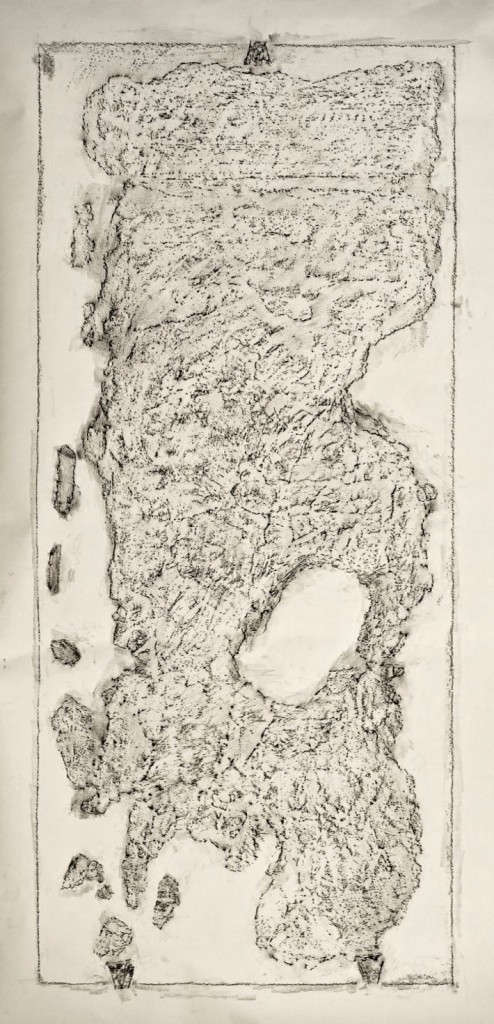
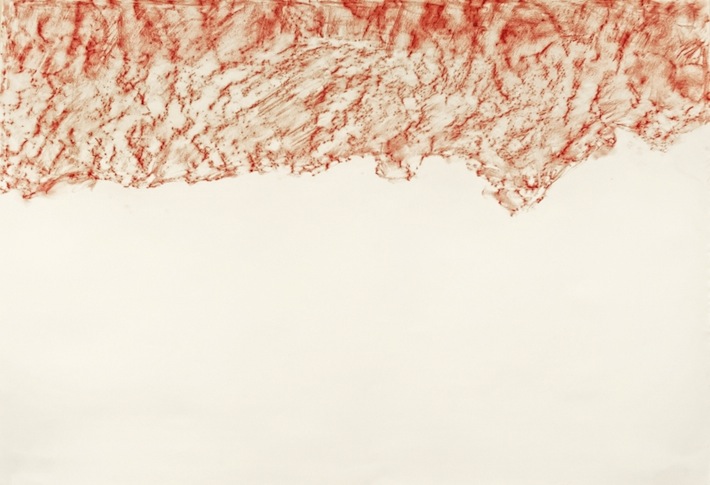
Here, McWilliams devoted himself to studying several of the ancient frescoes (c. XIV Century) which have been relocated in the local parish after the collapse of another local chapel during an earthquake, as well as the astonishing reliefs of a medieval alchemic arch that lies in a quiet village square. Mathew then spent several days by rubbing such reliefs and frescoes, leaving the latter covered by his works and at the same time exposing some cartes frottées at the local council hall. The technique, which in contemporary art is referred to as rubbings or frottage, is well known to almost everybody since school age (all of us, I think, spent some time transferring the mold of a leaf or of a coin by rubbing them against sheets of paper with some cheap wax pastels), as well as to the masters of Chinese printing for several thousand years. Because of the very simplicity of this practice, what is achieved by McWilliams is striking.
In fact, he compeletly renews the perception of these original art objects by creating, so to speak, an original from their own past. Then, on one hand, the works on display in the council hall were presented to the local visitors like a collection of fantastic maps of some unreal countries – and there were those who, staring at the papers, were sure of finding in the profiles of the frescoes traced on paper the drawing of a nearby lake or mountain. On the other hand, the large rubbed paper pieces left hanging in the church veiled with subdued, mysterious monochrome fields the underlying shapes of a gentle Madonna, a haughty archer missing his Saint Sebastian, some reserved saints – and there were those who, maybe during a mass, were certain that they had never noticed before those figures of melancholic beauty, stuck for centuries in some far away frescoes and brought to a new wonder by a contemporary artist who once had the chance to pass by the Sabinian woods. . Ph. Filippo Gianfelice")
. Ph. Filippo Gianfelice")
. Ph. Filippo Gianfelice")
. Ph. Filippo Gianfelice")
. Ph. Filippo Gianfelice")
. Ph. Filippo Gianfelice")